

CTR is one of those terms that keeps coming up in conversations among marketers, analysts and online-campaign specialists. It shows up in ad reports, newsletter stats and analytics tools - often as the first metric we look at when judging whether a campaign "landed." It's worth understanding exactly what this metric does and doesn't tell you, though, so you don't jump to the wrong conclusions. In this article we explain what CTR is, what values count as good, and how to genuinely improve it.
Table of contents
- 01 CTR - what is it?
- 02 Why does CTR matter?
- 03 What CTR is good?
- 04 How to improve CTR?
- 05 How to interpret and analyze CTR?
- 06 Summary
01 CTR - what is it?
CTR, or Click-Through Rate, is the click-through rate. It shows how many people clicked a link (an ad, a search result, a CTA button) compared to the total number of people who saw it. In other words, CTR answers a simple question: out of everyone who saw your message, what percentage found it interesting enough to click.
That's exactly why CTR is sometimes called the "attractiveness" indicator of a message. It says nothing about what happens after the click, but a great deal about whether the message itself - the headline, the graphic, the offer - grabs the attention of the right people.
The CTR formula is simple:
CTR = (Number of clicks / Number of impressions) × 100%
For example: if 10,000 people saw your ad and 200 clicked it, the CTR is (200 / 10,000) × 100% = 2%.
02 Why does CTR matter?
CTR is one of the most frequently analyzed metrics in Google Ads campaigns, newsletters and when assessing the effectiveness of organic results. Its popularity comes from being easy to measure and quick to show whether a message is working - without waiting for the final sale. On top of that, in paid campaigns (e.g. Google Ads) a higher CTR often lowers your cost per click, because ad platforms reward relevant, engaging ads. A well-monitored CTR therefore lets you not only judge the creative, but also genuinely save budget.
A high CTR may mean that:
- you chose your headlines, copy and graphics well,
- the message is well matched to the recipient's intent,
- the campaign was directed at the right target group.
A low CTR is often a signal that:
- something isn't working - e.g. the headline doesn't engage,
- the recipient doesn't understand what to do (weak CTA),
- the message misses their needs or is too generic.
03 What CTR is good?
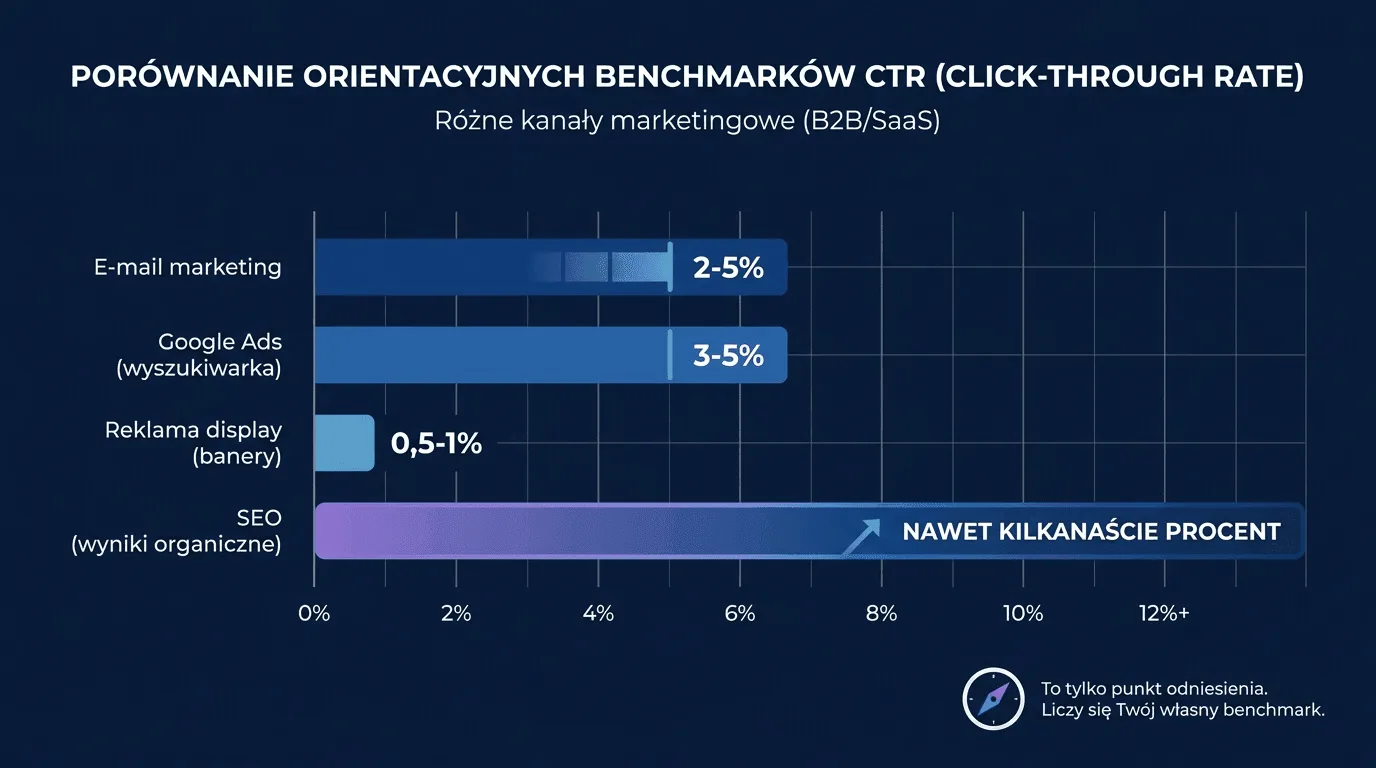
There's no single value that's "universally good." Context matters enormously here - a good CTR in a display ad would be a poor result in an email campaign to your own database. Rough benchmarks for individual channels are helpful, though:
- Email marketing: usually 2-5% (welcome and highly personalized campaigns can achieve much more).
- Google Ads (search network): on average 3-5%, and clearly higher for branded terms.
- Display advertising (banners): often just 0.5-1% - that's normal for this format.
- Organic results (SEO): heavily dependent on position - the top search results collect double-digit percentages and more.
Treat these numbers only as a point of reference. What matters most is your own benchmark - that is, how a given campaign performs against your previous results in the same channel.
04 How to improve CTR?
If your CTR is lower than you'd expect, check these elements first:
- Title and headline: the most common cause of low click-through. Test short, specific messages that spark curiosity.
- CTA: make sure the call to action is clear and speaks to a benefit.
- Fit to the recipient: more accurate segmentation and personalization almost always raise CTR.
- A/B tests: systematically compare variants of titles, graphics and CTAs - it's the surest path to improvement. More in the guide to A/B testing.
05 How to interpret and analyze CTR?
Optimizing CTR is a process that demands constant testing - a single measurement says little; only comparisons over time and between variants reveal what really works. Importantly, a high CTR in itself is no guarantee of success. You can pull plenty of clicks to a page with a catchy but misleading headline - if visitors don't find what they expected once they arrive, they'll simply leave, and you'll have paid for a click that delivered nothing.
That's why CTR is always worth analyzing together with other metrics that show what happens after the click:
- conversion rate (CVR) - whether the click turns into a real action (purchase, sign-up, contact),
- average time on page - whether the content holds the user's attention,
- bounce rate - whether visitors stay, or leave the page right away.
Only this combined view gives the full picture: a high CTR with a high conversion rate is a success, while a high CTR alongside a high bounce rate is a signal that the message promises something the page doesn't deliver.
06 Summary
CTR is a quick indicator of whether your message grabs attention - a high one means an on-target headline, graphic and fit to the recipient, while a low one is a signal that something needs work. Remember, though, that CTR alone settles nothing: it only counts in combination with conversion and on-page behavior. Treat it as a starting point for testing, not a goal in itself.