

AI models have been used in business for years - from process automation, through logistics, to data analysis. Their evolution means many companies can no longer imagine working without AI assistants such as ChatGPT or chatbots handling customer service. Today, however, AI agents are entering the stage - a new generation of autonomous systems that not only answer questions, but pursue business goals on their own.
Table of contents
- 01 How does an AI agent differ from an intelligent assistant?
- 02 How do AI agents work?
- 03 Where do AI agents prove their worth in business?
- 04 Summary
01 How does an AI agent differ from an intelligent assistant?
To understand what all the buzz is about, you first need to understand the difference between widely available assistants and personal AI agents.
- An AI assistant is a reactive tool - it answers questions and carries out single, clearly defined commands. Its role ends once it has generated a one-off result.
- An AI agent is a proactive system - it receives a goal from you and then takes the steps needed to achieve it on its own.
02 How do AI agents work?
An AI agent is an autonomous system that operates like an additional company employee. It not only understands commands, but independently plans, anticipates, determines the most effective actions, and then carries them out. An AI agent is capable of completing multi-step tasks in order to achieve the overarching goal it has been assigned.
An AI agent works according to a pattern: Plan → Execute → Analyze → Adapt
For it to work in this complex way, our agent needs its own "anatomy":
- A brain - usually a large language model (LLM), responsible for planning and reasoning.
- Senses - an AI agent not only maps out its own path, but also explores it, checking its surroundings and context - it will not head toward the goal blindly. This ability comes from access to the internet, integrations with databases / tools / applications, and the ability to read files. An AI agent also has its own memory: short-term - concerning the current task, and long-term - a history of actions and a database.
- Hands - once the agent has chosen its path, it is time to act. The APIs and tools the AI agent has access to are activated. These can be CRM systems, email inboxes, and even other AI agents.
Read also: Platforms used in marketing: CDP vs CRM vs DMP - pros, cons and benefits
03 Where do AI agents prove their worth in business?
AI agents can take over not just single tasks, but entire processes within a company. They work 24/7 - ready to do their job in a way optimized for the goal. Where are AI agents already finding their applications in business today?
AI agents in marketing
In marketing, speed of action and accuracy of decisions are what count. An AI agent can analyze changes in your industry on an ongoing basis, track trends, and watch the competition. A properly prepared AI agent executes an entire strategy: selecting keywords, drafting initial briefs and recommending actions that increase conversions.
Unlike a classic assistant, an AI agent does not wait until you ask it for an analysis. It will actively look for opportunities on its own - market shifts and micro-trends - so you can use them to gain an edge.
More effective sales - even B2B - with an AI agent
In sales, especially in the B2B sector, it is not only quality that matters, but also personalization. AI agents can take over "cold mailing" and "lead nurturing" tasks and raise them to a more effective level. What can this look like in practice?
- The AI agent searches company databases, social media (LinkedIn) and industry news in search of potential customers.
- It verifies the context that lets it determine whether the sales lead it has found is likely to be effective.
- It hands over a ready-made list to your sales reps, complete with lead information and suggested actions.
AI agents in logistics and e-commerce
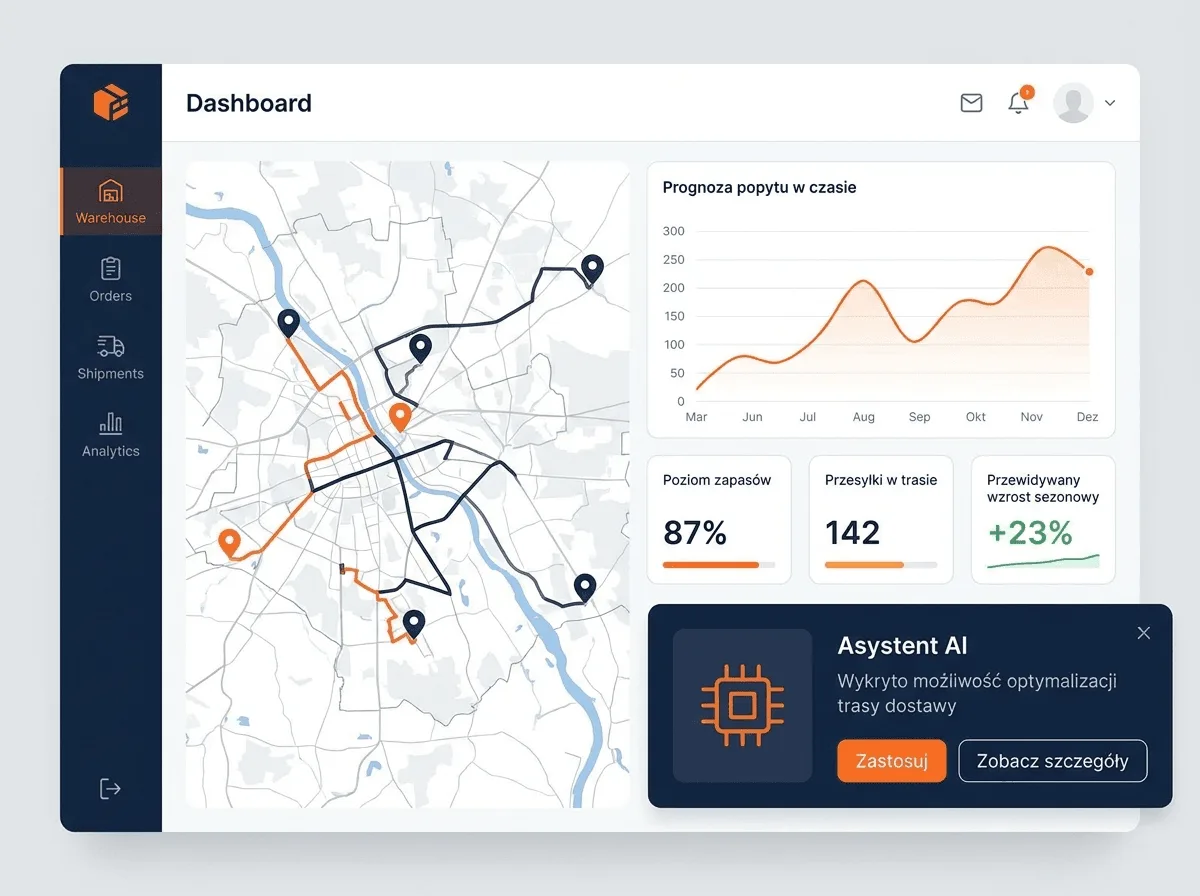
AI agents can also become a supply chain coordinator, operating at the intersection of warehouse systems (WMS), ERP and courier platforms. They are specialists in analyzing historical data, making predictions and monitoring the current state of product availability.
They can monitor shipment routes and point out possible optimizations, anticipate seasonal changes and adjust the warehouse accordingly - and all of this on an ongoing basis, 24/7 and without the involvement of an additional employee.
Discover also: Using AI in business: Optimization, personalization and automation with artificial intelligence
Customer service, reimagined
Personalization with AI can also be taken to a whole new level thanks to the use of AI agents. They can analyze returns and complaints tickets, extract the most important information and automatically update systems - without needlessly tying up employees.
If an order gets stuck or an error appears, an AI agent can detect such problems on its own, inform the customer about the order status and trigger the appropriate procedures within the company to resolve the complication.
See how the Persooa team has already helped other companies achieve success through new technologies and automation - check out our Case Studies!