

A replenishment email is a great way to increase customer retention, improve the customer experience and generate steady, predictable revenue.
Table of contents
- 01 What problems does a replenishment email solve?
- 02 What stages does a replenishment campaign consist of?
- 03 What additional options are there?
- 04 What is worth knowing about repeat purchases?
- 05 Which industries does a replenishment email work best for?
- 06 Summary
01 What problems does a replenishment email solve?
Problems solved by implementing a replenishment email:
- Higher customer loyalty, which shows up in more frequent purchases.
- Choosing the optimal time for a customer's repeat purchase.
- Predictable revenue, which makes it easier to plan sales and optimize key metrics.
- Higher product margin, thanks to building a habit of customers regularly returning to the store.
Encourage customers to reorder items they bought earlier to meet their needs.
A replenishment campaign increases the chance of a purchase and, in turn, increases revenue. It is especially useful in the fast-moving consumer goods (FMCG) sector, for products that run out quickly, such as coffee, milk, diapers, pet food and over-the-counter medicines.
02 What stages does a replenishment campaign consist of?
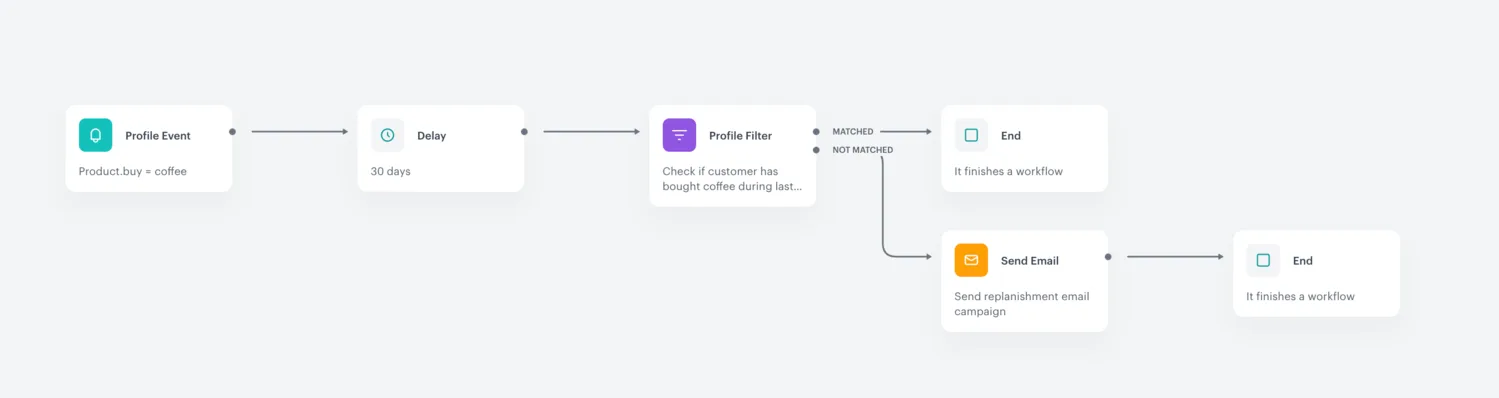
Step 1: In the first step, we define a purchase from a category - for example, "coffee" - which will be used to qualify all users who recently bought a product from that category. You can also select a specific product you want to remind the customer about.
Step 2: In the second step, we decide how long to wait before sending the next email. As the person managing the online store, you should determine this yourself or with the help of the analytics available to you. You can set this period, for example, by calculating the average number of days between the first and second purchase.
Step 3: In the third step, you check whether the customer has made a purchase from the chosen category or product. If the customer has not made a purchase, you can send the campaign. If they bought coffee within the last 3 days, that customer exits the path, and after another 30 days you can send them a further reminder.
03 What additional options are there?
- Try other available communication channels if your customers are not responding in the ones you use. You can use channels such as SMS, web push or mobile push. The average CTR for SMS campaigns is 19%.
- If the customer has not responded on any channel, it may be worth retargeting them on Facebook using a dedicated automation.
- With advanced AI predictions, you can also choose the optimal channel and send time for a specific customer.
- Try a creative approach to replenishment emails by using non-standard content, such as riddles, gamification or draws for special coupons.
04 What is worth knowing about repeat purchases?
- The average e-commerce store earns 41% of its total revenue from just 8% of its customers (that is, repeat buyers).
- Customers who have purchased from your company twice are nine times more likely to convert than first-time buyers.
- The top 10% of customers are worth, on average, six times more than the other 90%.
- Customers who make repeat purchases spend up to three times more than customers with a single purchase.
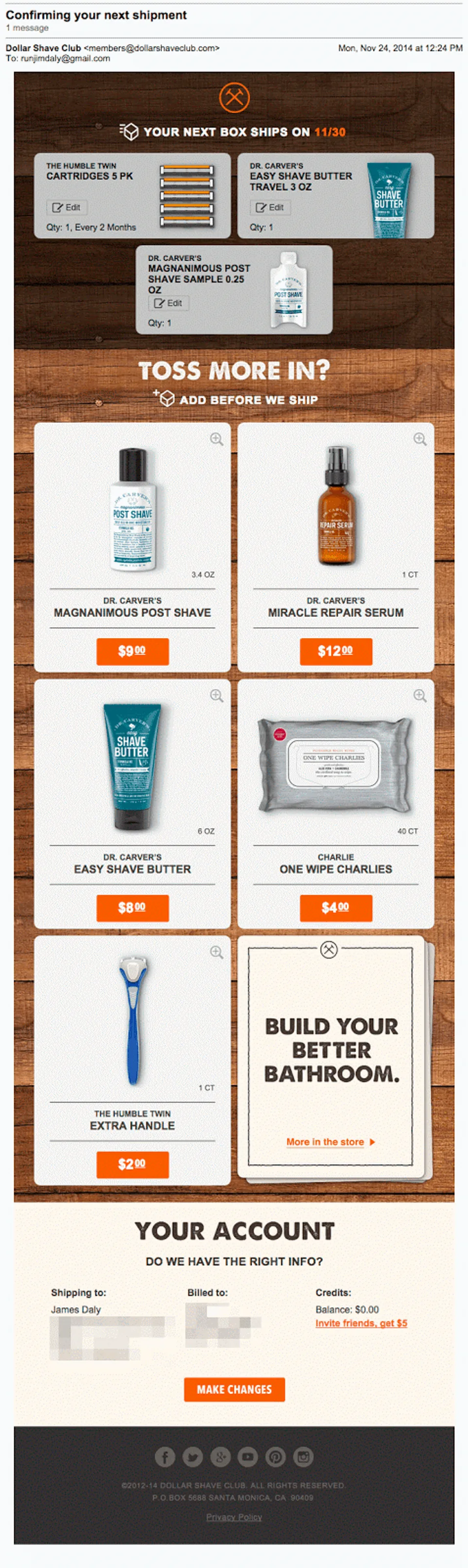
05 Which industries does a replenishment email work best for?
Essentially any industry in which the product can be shipped by regular mail or courier and the purchase frequency is at least twice a year:
- pet stores,
- bookstores,
- cosmetics stores,
- online grocery stores,
- over-the-counter medicine stores,
- household chemical stores.