

You can't improve what you don't measure. KPIs - key performance indicators - translate business goals into concrete numbers that you can track and optimize. The art lies in choosing the right ones from the dozens available and assigning them to the appropriate roles in the organization - from the board to individual specialists.
Table of contents
- 01 What are KPIs?
- 02 What characteristics do good KPIs have?
- 03 What are the two approaches to assigning goals in an organization?
- 04 Which KPIs should you use in marketing and e-commerce?
- 05 Why is it worth analyzing KPIs in every organization?
- 06 Summary
01 What are KPIs?
Right at the start, though, it's worth taking a closer look at the very definition of KPI - a term used so often in marketing and e-commerce. It's an abbreviation of the English phrase Key Performance Indicators. It brings together a range of data that lets you precisely determine whether your activities are producing the intended effects and moving you closer to a defined business, strategic, or operational goal.
Within KPIs, however, there's no way to point to a single definitive list of the metrics you should use. Every company, industry, or even team can individually decide which ones are most relevant to the activities being carried out. Completely different metrics come into play for direct sales, others for running social media campaigns, and others still for preparing personalized user experiences.
02 What characteristics do good KPIs have?
The purpose of KPIs is to monitor as well as measure the effectiveness of the campaigns, strategies, or other activities being carried out. Across different KPIs, there are a few common characteristics:
- Measurability - it makes it possible to create summaries, comparisons, and analytics and, in the future, to optimize your activities. That's also why KPIs have a numerical value.
- Objectivity - the results must be transparent and unambiguous so that it's possible to state a specific value.
- Timeliness - they should be updated systematically so that they reflect current results. It's therefore worth analyzing them from time to time - those that affect day-to-day work can be updated even every few hours, while others (more complex ones that analyze areas over a longer period) once a quarter or even once a year.
- Alignment with goals - it lets you determine whether the chosen direction of your activities is justified.
03 What are the two approaches to assigning goals in an organization?
The organizational approach
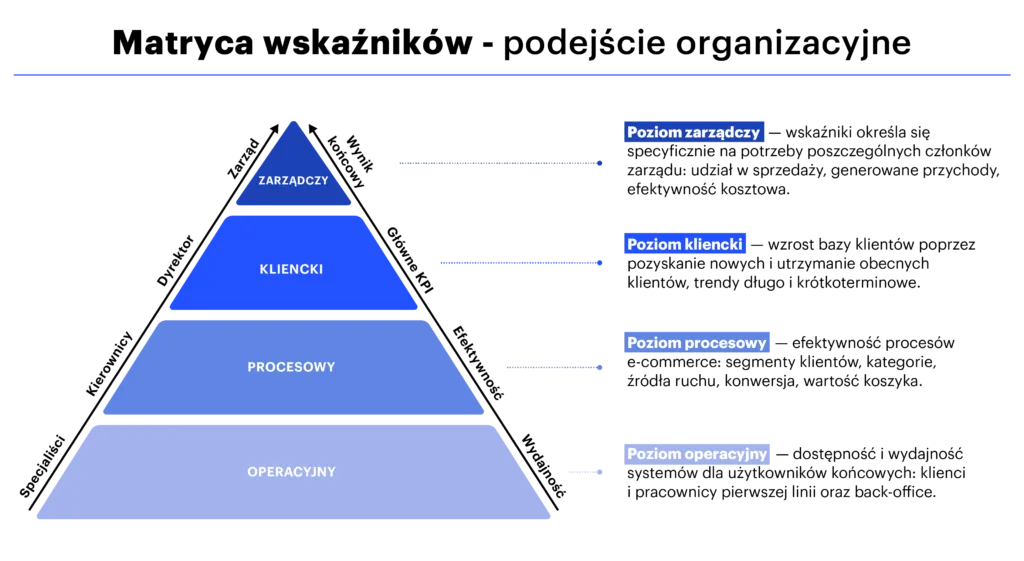
The organizational approach to assigning goals is based on a given company's organizational structure. In this approach we distinguish 4 levels:
- Management - indicators such as the share of digital channels in sales, e-commerce revenue generated, e-commerce cost efficiency, and customer satisfaction.
- Customer - the main KPIs, often assigned to sales directors or e-commerce managers, such as growth of the customer base through acquiring new customers and retaining existing ones, as well as long- and short-term trends.
- Process - process indicators are assigned to the managers responsible for a given area related to digital channels, e.g., product managers, digital marketing managers, e-commerce managers. Example process indicators define: e-commerce process efficiency, customer segments, traffic sources, conversion, and cart value.
- Operational - an area quite often overlooked in definitions and KPIs, but extremely important, because it genuinely affects all of the above. To put it simply, the operational level concerns the availability and performance of the systems that affect how e-commerce runs. It's assigned to specialist functions across various areas of the organization, especially in IT departments.
The customer approach
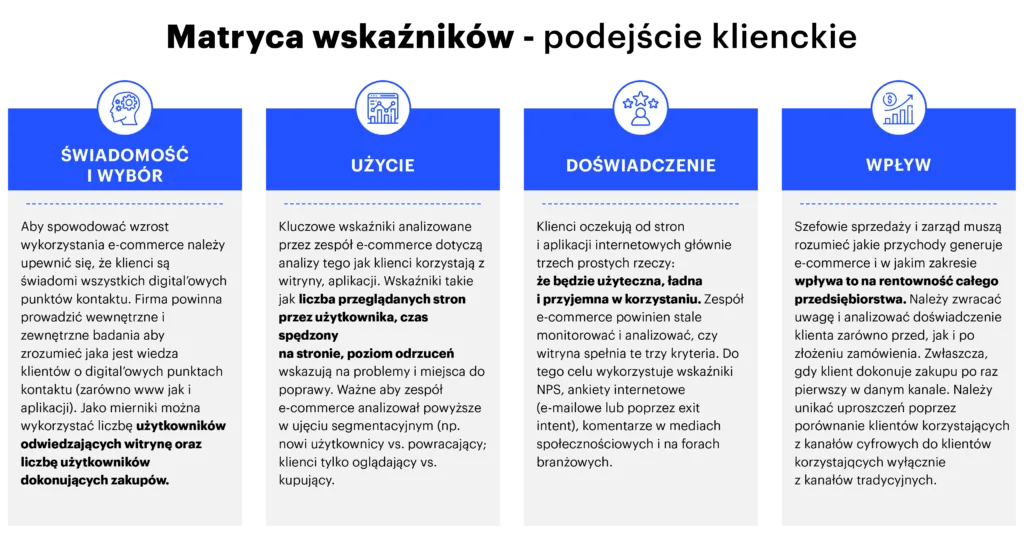
We can also arrange marketing KPIs as a customer matrix. We distinguish 4 areas aligned with the customer journey:
- Awareness and choice - to drive growth in e-commerce usage, you need to make sure that customers are aware of all the digital touchpoints with the company. The company should conduct internal and external research to understand what customers know about the digital touchpoints (both the website and the mobile app). Useful metrics here include the number of users visiting the site and the number of users making purchases.
- Usage - the key indicators analyzed by the e-commerce team concern how customers use the website or app. Metrics such as the number of pages viewed per user, time spent on the site, and bounce rate point to problems and areas for improvement. It's important that the e-commerce team analyzes the above by segment (e.g., new users vs. returning; browse-only customers vs. buyers; segments within purchasing categories).
- Experience - customers expect only three simple things from a website or app: that it will be useful, easy, and pleasant to use. The e-commerce team should continuously monitor and analyze whether the site meets these three criteria. For this, they use NPS metrics, online surveys (by email or via exit intent), comments on social media and on industry forums.
- Impact - sales leaders and the board need to understand how much revenue e-commerce generates and to what extent it affects the profitability of the entire company; they should pay attention to and analyze the customer experience both before and after an order is placed, especially when a customer is making a purchase in a given channel for the first time. Oversimplifications should be avoided when comparing customers who use digital channels with customers who use traditional channels only.
04 Which KPIs should you use in marketing and e-commerce?
At the board level
- Revenue growth - the value of sales transactions in the e-commerce channel, measured year over year (YoY).
- E-commerce share of company revenue - the percentage share and value of sales transactions completed in e-commerce.
- Market share - the size of the market for a given industry, from which the company's share is calculated.
- NPS (net promoter score) - measures the level of customer loyalty and willingness to recommend the brand: NPS = % promoters − % detractors.
- CSAT (customer satisfaction score) - measures the level of customer satisfaction with a purchase: CSAT = number of satisfied customers / number of all customers × 100%.
At the director level
- Conversion (CR) - the percentage of users visiting the site who completed a desired action. CR = number of conversions / number of visits to the site × 100%. Benchmarks range between 2 and 10%.
- Average order value (AOV) - AOV = total value of orders / number of orders.
- Basket Size - refers to the number of products sold in a single purchase.
- Customer acquisition cost (CAC) - CAC = total cost of acquiring customers / number of customers acquired. Benchmarks: CAC should not exceed 25% of CLV.
- CLV (customer lifetime value) - the total revenue a company earns from a customer over time.
- Return Rate (RR) - Return Rate = number of returned products / number of products sold × 100%.
At the manager level
Site and store effectiveness indicators:
- Bounce Rate (BR) - Bounce Rate = number of visits that resulted in leaving the page / number of all visits × 100%. Range: from 20% to 80%.
- Engagement Rate (ER) - Engagement Rate = number of interactions / number of visits to the site × 100%.
- Returning Visitors Rate (RVR) - Returning Visitors Rate = number of returning visits / number of all visits × 100%.
- Customer Retention Rate (CRR) - Customer Retention Rate = number of customers who made repeat purchases / number of all customers × 100%.
Email communication effectiveness indicators:
- Email Open Rate - number of email opens / number of emails sent × 100%. Benchmarks: 15-25%.
- Email Click-Through Rate - number of link clicks / number of opened emails × 100%. Benchmarks: 2-5%.
Advertising effectiveness indicators:
- Impressions - number of ad impressions / number of visits to the site.
- CTR (Click-Through Rate) - number of clicks / number of ad impressions × 100%.
- CPC (Cost Per Click) - total cost of the ad campaign / number of clicks.
At the specialist level
Example indicators:
- Page load time
- Number of mobile app downloads
- Data loading speed
- Click to call
- Share of self-service vs. assisted service (advisor vs. bot)
- Wait time to connect with a chat agent
- BOPIS (buy online pick up in store) ratio
- Delivery rate indicators
- Out-of-stock rate
05 Why is it worth analyzing KPIs in every organization?
KPIs are helpful when:
- an organization wants to focus on its most important, strategic goals and monitor progress toward them on an ongoing basis;
- it's necessary to measure the progress of the campaigns being run;
- there's a desire to detect areas that need improvement or errors that are weakening the results of the activities being carried out;
- help is needed in making decisions;
- a company wants to define what results are expected from the team carrying out the tasks;
- there's a desire to communicate in a shared language that's understandable across the entire company.
06 Summary
Well-chosen KPIs turn business goals into measurable, concrete numbers and give the whole organization a common language for talking about results. The key is matching the indicators to the level and the role - the board is interested in some metrics, managers in others, and specialists in others still. Instead of tracking everything, pick a few indicators genuinely tied to your goals, monitor them regularly, and optimize your activities based on them.