

In an online store, the search bar is no longer just a feature - it has become an essential strategic element. Interestingly, it is not merely a convenience for browsing your catalog; today it is your sales engine, one that can drive e-commerce revenue more effectively than it might seem at first glance.
Even so, many stores still rely on outdated solutions. They base their search on "lexical" logic - matching the literal characters of the terms typed in, instead of responding to human intent. Semantic Search is the evolution of that approach - from treating an online store as a static catalog to building an intelligent, intent-aware ecosystem that fills carts rather than driving up your bounce rate.
Table of contents
- 01 What is Semantic Search?
- 02 How does Vector Search differ from Semantic Search?
- 03 What sets Semantic Search apart in practice?
- 04 How does Semantic Search affect e-commerce conversion?
- 05 What does a Semantic Search implementation look like?
- 06 The power of Semantic Search in your e-commerce
01 What is Semantic Search?
To understand what semantic search is, we need to look at how people actually use search and what they type into it. Unlike traditional keyword matching, Semantic Search uses artificial intelligence to interpret context, synonyms and the hidden intent behind a query. The very act of "searching" shows that the customer is actively opening up to possibilities and broadening the context. So why not make the most of it?
The essence of semantic search lies in its ability to build a bridge between how a customer describes a product and how that product is indexed in the database. If a user searches for "an outfit for a summer gala," a semantic engine understands the relationship between the word "gala" and "formal wear," delivering relevant results even if the word "gala" never appeared in the product description.
You may also be interested in: AI in the company - how to prepare your organization for an artificial intelligence implementation?
02 How does Vector Search differ from Semantic Search?
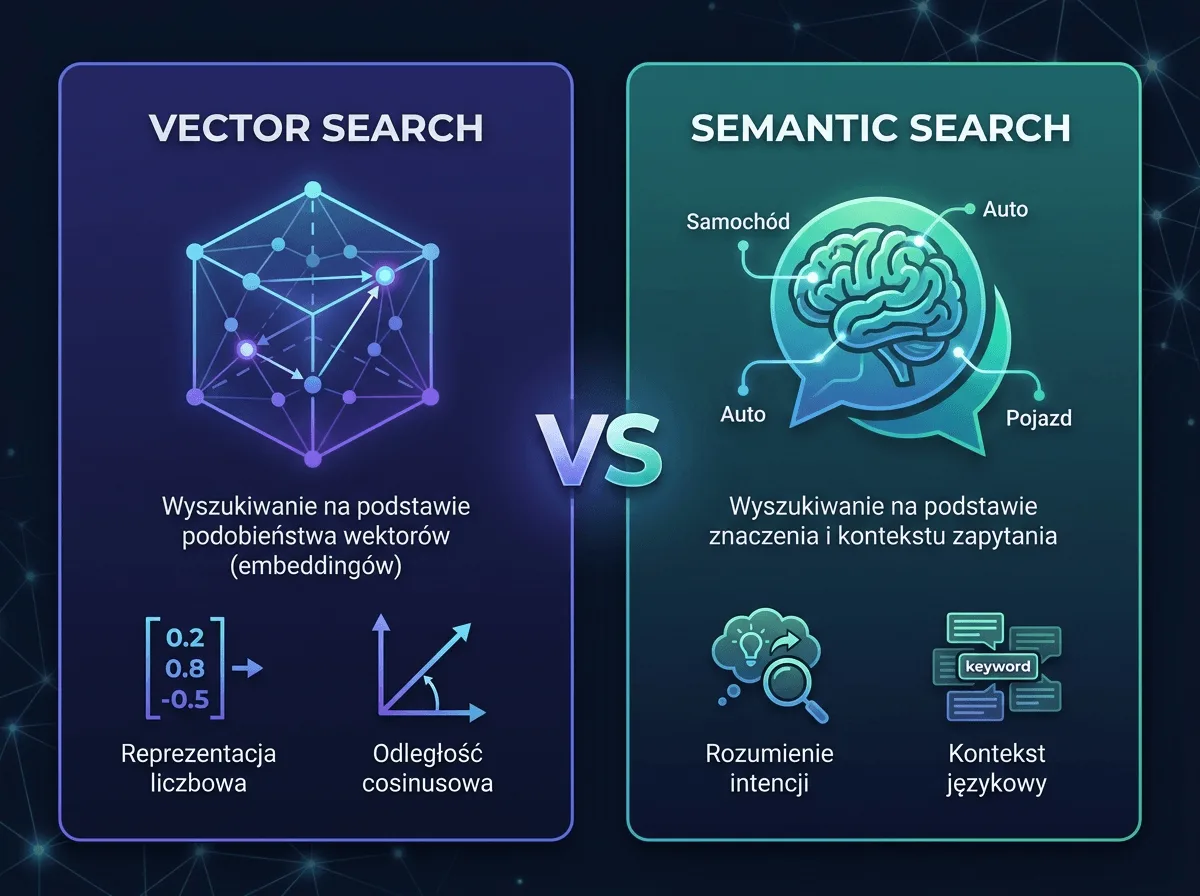
In professional circles these terms are often used interchangeably, but it is worth understanding the subtle difference between them. Semantic Search versus Vector Search is the relationship between a goal and a tool.
- Semantic Search is the concept: we want search to "understand" the user and deliver results based on meaning and intent.
- Vector Search is the technology that makes it possible: a mathematical approach in which words, phrases and even images are converted into vectors (numbers) in a multidimensional space. Words with similar meanings end up "close" to one another.
Thanks to this mechanism, Vector Search plots data points across a virtual space. When a query comes in from the user, the engine identifies the products that are mathematically "closest" to the searcher's intent.
03 What sets Semantic Search apart in practice?
| Feature | Traditional search | Semantic & Vector Search |
|---|---|---|
| Mechanism | Keyword matching | Mathematical analysis of meaning (vectors and their positions) |
| Handling synonyms | Requires manual definition | Works automatically (understands context) |
| Long queries | Often returns "no results" | Handles natural language and its interpretation |
| Results | Strictly literal | Broadened by context, based on purchase intent, more relevant |
04 How does Semantic Search affect e-commerce conversion?
Search is the most powerful sales tool on your site. Users who use it usually start out with higher purchase intent than those who only browse categories. Moving to a semantic-first architecture therefore has a direct impact on the bottom line - making a purchase - across three touchpoints:
1. Eliminating the "No products found" page
This is the single biggest conversion killer. Standard search is fragile - a single typo or the use of a synonym can lead to a "No products found" page, and that is the most common exit point in e-commerce. Semantic Search acts as a lifeline, keeping the path to purchase open regardless of the terminology used and always leading the customer to the offer.
Read also: Lead nurturing - what it is and how to "nurture" your future customer
2. Handling conversational and voice "long-tail" queries
Today, natural-language queries - often typed or dictated by voice - are replacing short key phrases. Users ask questions like: "what is the best waterproof jacket for heavy rain that isn't too heavy?" Semantic search deconstructs these complex strings to identify the key attributes (waterproofing, durability, low weight) and present the perfect choice.
3. Personalization and synergy with your data
At Persooa we specialize in integrating these capabilities with powerful platforms such as Synerise and Salesforce Marketing Cloud. By layering data from a Customer Data Platform (CDP) onto semantic search, the results become personalized. If a user's intent vector for the term "watch" sits close to the concepts "luxury" and "minimalist" (based on their history), the engine automatically prioritizes products with those characteristics.
05 What does a Semantic Search implementation look like?
E-commerce leaders do not build these models from scratch - they reach for ready-made tools and orchestrate them the right way. Our approach focuses on deploying world-class solutions that integrate seamlessly with the processes already running in your company:
- AI Search: Processing user queries in real time, delivering results in a fraction of a second, which significantly boosts your click-through rate (CTR).
- Data integration withSalesforceor theSyneriseplatform: The data collected from search can now feed your CRM, delivering even more relevant recommendations and enabling better optimization of your marketing activities.
Your next step is to activate the dialogue with your customer. By integrating tools such as Web Chat or WhatsApp, you can reach customers in the comfortable environment they use every day. An unfinished transaction? Or perhaps maintaining the relationship after a successful purchase? Put your data and the power of technology to work and turn a one-time click into a loyal customer.
06 The power of Semantic Search in your e-commerce
Understanding semantic search means shifting from treating your store as a product catalog to casting it in the role of an intelligent advisor for your customer. With customer acquisition costs (CAC) steadily rising, it is no longer volume but the ability to turn every lead into a conversion that spells success. Matching intent is today the most effective way to reduce abandoned carts and exits from your site. Put Semantic Search to work in your store and watch your ROI climb.