

You only get one chance to make a good first impression. In e-commerce, that first handshake is often the welcome email - the message that gives a company its character and personality and builds a real relationship with the customer. Or at least that's the role it should play.
Statistics show that welcome emails have an average open rate exceeding 50%, which makes them the most effective sales tool in your arsenal - if you seize the opportunity properly. In this article you'll find a few tips to help you craft an effective welcome email, along with ready-made templates you can implement right away.
Table of contents
- 01 What is a welcome email?
- 02 Why is it worth implementing welcome emails?
- 03 How to create welcome emails? Best practices
- 04 A ready-made welcome email template
- 05 How will Persooa help you optimize your welcome emails?
- 06 FAQ: the most common questions about welcome emails
01 What is a welcome email?
A welcome email is an automated message sent to new subscribers or customers immediately after they sign up for the newsletter, register an account, or make their first purchase. It is the moment when the customer's attention is at its highest - which is why it is the best opportunity to build a relationship with the user and to shape a positive brand image from the very first interaction.
A welcome message can take various forms (including SMS, a PUSH notification,email, a pop-up), but the most commonly used is email. This kind of message should engage the recipient right away and effectively steer them toward the actions you expect - for example, completing a preferences survey, downloading a discount code, visiting the store, or making a purchase.
02 Why is it worth implementing welcome emails?
Users who provide their details and show a willingness to subscribe to the newsletter are signaling their interest in the brand's assortment, in the informational value they found on your site, or in additional benefits (for example, the desire to obtain attractive discounts).
This interest is often driven by the customer's current needs. That's exactly why, at the moment of signing up for the newsletter, the user's curiosity reaches its peak. It's worth keeping this in mind when preparing your email marketing campaign strategy - welcome campaigns generate a high open rate, at a level higher than 50%.
Beyond that, a welcome message serves goals such as:
- confirming the action and building trust: The welcome email reassures the user that the registration or purchase process completed successfully.
- shortening the path to purchase: By thanking the customer for choosing the brand, they feel reassured in their choice, and an additional discount code motivates them to make their first transaction.
- introducing the brand and educating: The welcome email is a good tool for building customer awareness of the brand - that is, presenting its purpose, vision, and values, along with a short description of the assortment, products, services, or current promotions.
- starting a long-term dialogue with the customer: The welcome email lets you build a long-term relationship with the customer and get to know their preferences more precisely, for example through a click on a specific category - which also lets you further segment your customer base and personalize your next actions more effectively.
03 How to create welcome emails? Best practices
1. Hyper-personalization throughout the email
It's important to open the communication with a direct, first-name greeting, but don't stop there - make use of the data you've collected. You can personalize the welcome email using browsing or purchase history on your site, the customer's location, or their preferences. You'll find tips on how to collect data for personalization in our article on ways to gather communication consents.
2. Craft a catchy subject line
The subject line decides whether the email gets opened at all. Go for a short, specific, curiosity-piquing message, ideally personalized. You'll find more on what drives open rates in our article on Open Rate.
3. Focus on one clear goal and CTA
Don't try to say everything at once. Decide what action you want the recipient to take (for example, claiming a discount, completing their preferences, or a first purchase) and highlight it with a single, clear CTA.
4. Offer a welcome benefit
A welcome discount, free shipping, or extra loyalty-program points effectively motivate a first transaction. Take a look at the various discount strategies you can use.
5. Introduce the brand and its values
Use the moment of peak attention to briefly explain who you are, what sets you apart, and why the customer has come to the right place. This builds trust and brand identity from the very first interaction.
6. Set expectations about communication
Tell the recipient what they can expect: how often you'll write and what kind of content they'll receive. Transparency reduces unsubscribes and builds a positive attitude.
7. Add social proof
Customer opinions and ratings lend the brand credibility in the eyes of a new recipient. It's worth showing them right in the welcome email - learn how to collect product reviews after purchase.
8. Recommend matching products
If you already know the customer's preferences or browsing history, include personalized product recommendations. This shortens the path to the first purchase.
9. Optimize the message for mobile devices
Most emails are opened on a phone, so make sure the layout is readable, the text is large enough, and the buttons are easy to tap with a thumb.
10. Turn a single email into a welcome sequence
Instead of one message, plan a welcome scenario made up of several emails spread out over time. This lets you gradually build the relationship and guide the customer toward a purchase.
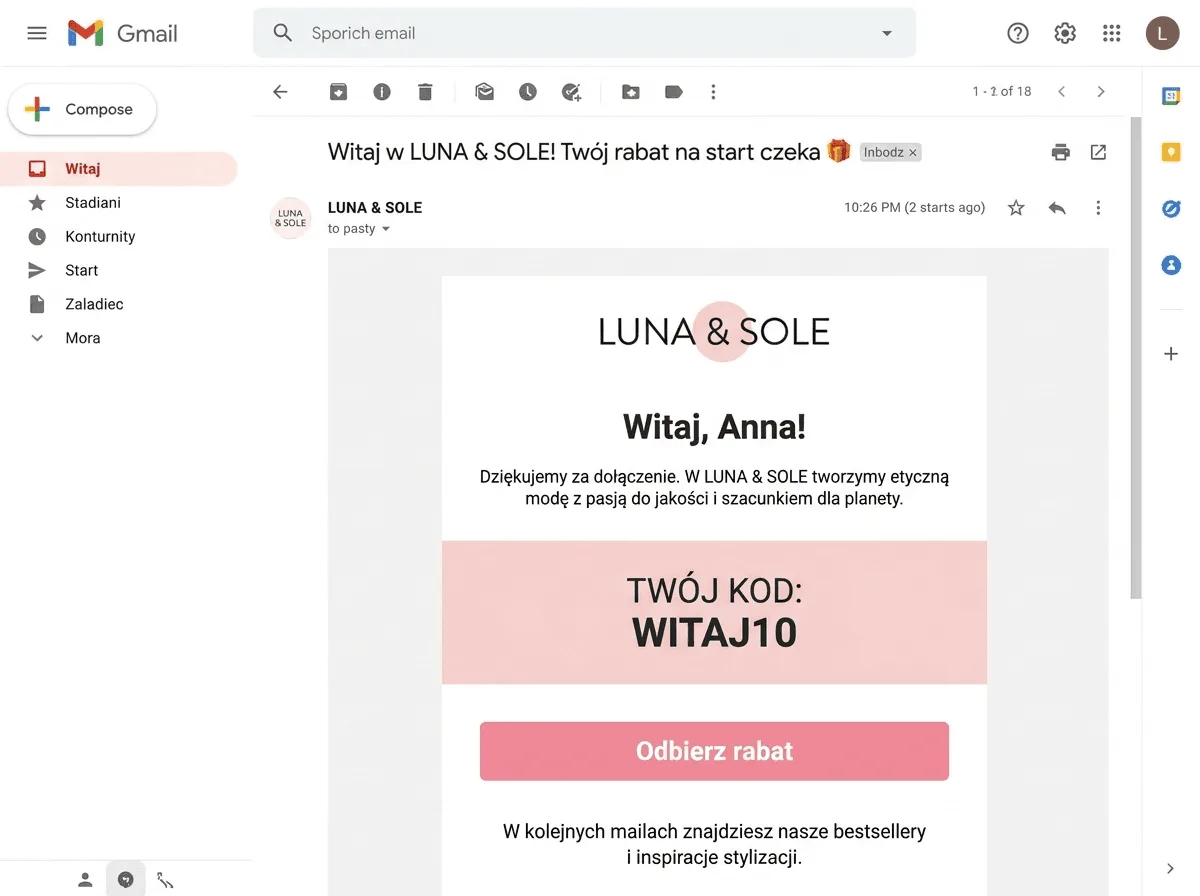
04 A ready-made welcome email template
Below is a simple skeleton you can adapt to your brand:
- Subject line: "Welcome to [brand]! Your starter discount is waiting 🎁"
- Greeting: a direct, first-name greeting and a brief thank-you for signing up/purchasing.
- Value: one sentence about what sets the brand apart.
- Benefit: a clearly displayed discount code or another welcome perk.
- CTA: a single button directing to the desired action (e.g., "Claim your discount").
- Next step: a preview of what the customer can expect in the following messages.
05 How will Persooa help you optimize your welcome emails?
At Persooa, we help turn the welcome email from a formality into a real sales tool. We combine customer data with automation and personalization so that every message arrives at the right moment and with the right content. We'll design a welcome sequence with you, select the benefits, and configure scenarios based on recipient behavior - so that from the very first interaction you build loyalty and increase conversion.
06 FAQ: the most common questions about welcome emails
When should you send a welcome email? Ideally immediately after sign-up or the first purchase - that's when the customer's attention and engagement are at their highest.
Should a welcome email include a discount? A discount is a great way to motivate a first transaction, but it isn't mandatory. In premium brands, early access to a collection or exclusive content works just as well.
One email or a sequence? A sequence of several messages usually works better than a single email - it lets you gradually introduce the brand and guide the customer toward a purchase.