

1971 was a breakthrough year for the way we understand marketing today. That was when the first message was sent using an internet mailbox. It was not particularly elaborate, but it offered hope for creating an entirely new form of communication. Today, email marketing makes it possible to run an effective marketing strategy through messages sent to a collected user base. It is undoubtedly one of the key elements of every company's marketing efforts.
Table of contents
- 01 Email marketing - what is it?
- 02 Email marketing - how to start running a campaign?
- 03 What are the advantages of email marketing?
- 04 What are the disadvantages of email marketing?
- 05 What are the types of email marketing?
- 06 Summary
01 Email marketing - what is it?
Marketing conducted through email communication is a form of direct action that uses electronic mail to promote products or services. It involves contact with potential or existing customers. It serves to inform them about news, special promotions, or the next steps in the purchase journey by integrating those activities with marketing automation.
02 Email marketing - how to start running a campaign?
To make the most of what this type of marketing activity has to offer, it is worth getting familiar with the key principles that will help increase the effectiveness of the work you carry out.
Choosing the right tool
Running email marketing campaigns will be far simpler and more effective with the right marketing automation tool.
Defining the goal of the campaign
Before sending an email marketing campaign, you need to define the goal it is meant to achieve. Goals may include, among others: welcoming new customers and beginning to build a relationship, increasing user engagement, retaining customers, and delivering content that is valuable to them.
Collecting leads and maintaining database quality
The database used to send campaigns must be built in compliance with the law, i.e. the user must give their consent to receive messages electronically.
Segmenting the recipient list
To deliver your message to recipients precisely, you need to segment them properly. It is not worth sending a campaign to all users.
Personalizing email content
Personalization can take place on several levels. The most basic form of content customization in email marketing is addressing the user directly - for example, by using personal data such as the customer's first name.
A catchy and/or personalized subject line
The subject line is the first element the recipient of a message will see. That is why it should be not only specific and persuasive, but also written in a way that encourages the reader to open the email.
A clear CTA
A Call to Action is usually placed at the end of a message to encourage the user to take a specific action.
Message responsiveness
Today, the ability to use an email inbox across different devices is an undeniable advantage for users (as many as 53% of emails are opened on mobile devices).
Visually appealing design
Email marketing is not just about the content you want to convey. The way you choose to present it is what delivers the right effect.
Running tests
To achieve the best possible results, it is worth testing different approaches. Experimenting with different subject lines, content formats, images, or CTAs will let you find out what holds the user's interest over the long term.
Monitoring, analytics, and optimization
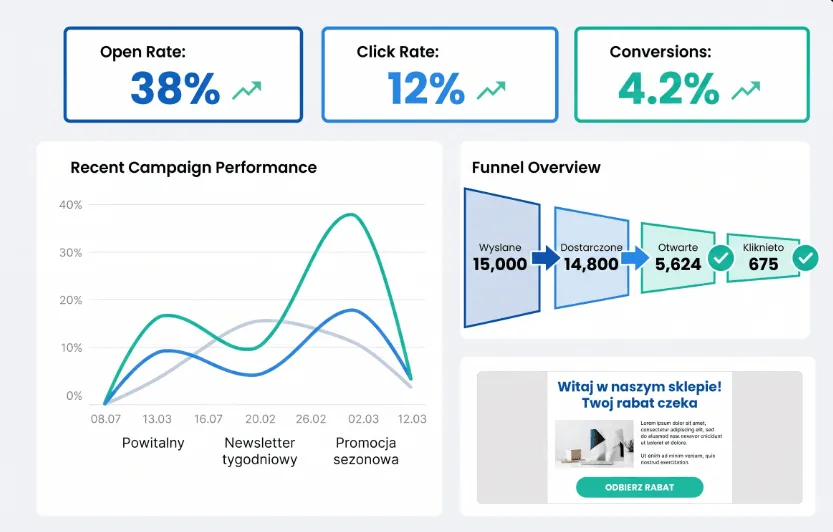
The last, but equally important, element when running an email marketing campaign is the regular analysis of the results of your efforts and the keeping of statistics.
03 What are the advantages of email marketing?
One of the significant advantages of email marketing is that it prompts users to take specific actions after receiving a message. It is worth noting that email marketing is an effective way to build relationships with customers.
Additional advantages also include:
- the low cost of sending messages to a wide audience,
- a strong sales-driving character,
- the ability to stay in contact with the user more frequently,
- a more personal form of communication,
- segmenting users to match content as closely as possible,
- tracking and analyzing recipients' reactions,
- independence from social media.
04 What are the disadvantages of email marketing?
Heavy competition
Email marketing is a fairly popular strategy for running online campaigns. This also means that many companies are competing for the attention of a similar target audience.
Message size
It is also worth paying attention to the weight of the message itself. When it contains a lot of content, its size grows.
Spam
A great many of the messages that reach recipients end up in spam. That is why it is worth taking an individual approach.
Competing for engagement
The fact that a user is in your mailing contact base does not necessarily mean they will read your messages.
05 What are the types of email marketing?
Types of email messages can be divided into: promotional, transactional, and relational.
Welcome emails
They are what begins the relationship between the user and the brand. Welcome messages serve to confirm registration while introducing the customer to the brand's world.
Recurring messages - the newsletter
A newsletter is intended to inform subscribers about current activities - these can be news about ongoing promotions.
Abandoned cart emails
Abandoned cart messages are a good way to remind users about the products they selected but did not purchase.
Seasonal campaigns
The holiday season, sales periods, and Black Friday are moments when brands outdo one another in sending standout campaigns.
06 Summary
Email marketing remains one of the most effective and most affordable channels at a marketer's disposal - it provides direct contact with the customer, a high return on investment, and independence from social media algorithms. The key, however, is not mass sending but quality: a legally compliant database, good segmentation, content personalization, a catchy subject line, a clear CTA, and continuous testing. Match the type of message to your goal (welcome emails, newsletter, abandoned cart, seasonal) and analyze your results regularly, so that over time you communicate more and more effectively.